The Tensor G5 chip in the Pixel 10 represents Google’s first entirely in-house ARM-based design. Utilizing TSMC’s 3nm process, it enhances performance, efficiency, and boot speed by 30%.
Unique AI features may set the Pixel 10 apart from other Android phones. Additionally, code leaks suggest the existence of a Pixel 10 Pro Fold, which could offer 25% faster loading times.
Google Pixel 10 Series: The Tensor G5 Revolution
From the Nexus era to the Pixel dynasty, Google’s smartphone journey has been a rollercoaster. Now, the Google Pixel 10 series is poised to redefine the brand’s legacy.
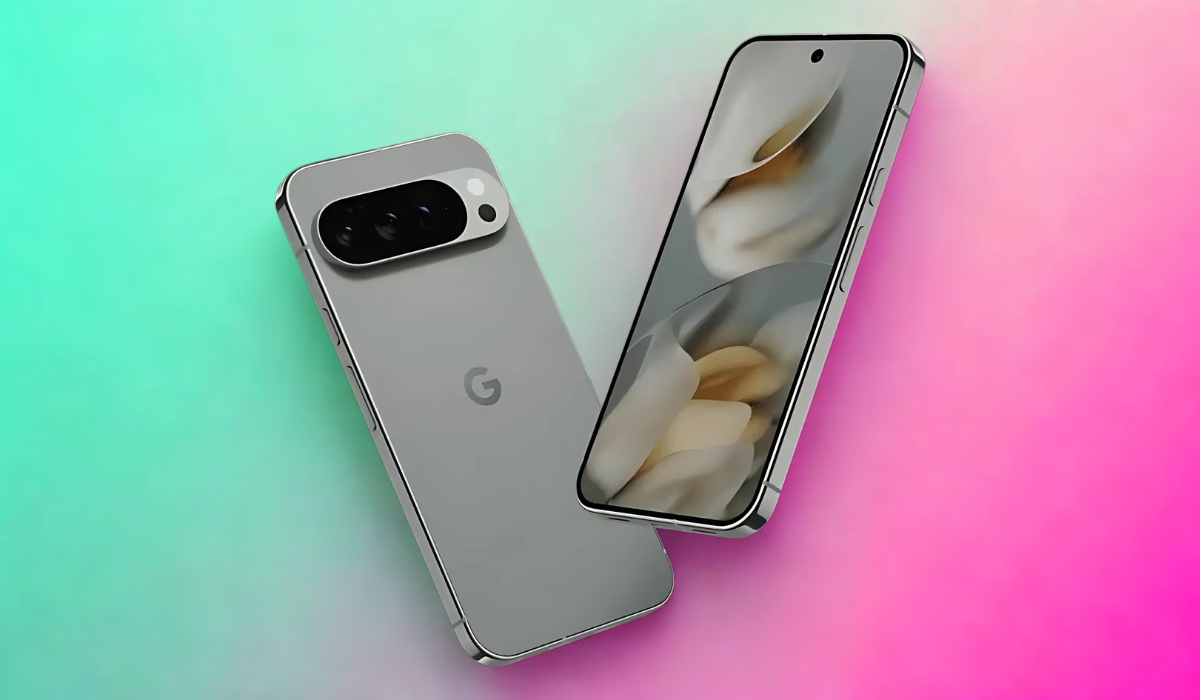
Slated for a preview at Google I/O 2025, this lineup marks a seismic shift: the Tensor G5 chip, Google’s first fully custom ARM-based processor, built on TSMC’s cutting-edge 3nm technology. Let’s unpack why the Google Pixel 10 series could be the ultimate iPhone challenger.
From Nexus to Pixel: A Decade of Evolution
Google’s hardware ambitions began with Nexus phones, partnering with HTC, LG, and Samsung. But the Pixel line, launched in 2016, signaled a bolder vision. Early models like the Pixel 4 introduced Face ID-rivaling 3D facial mapping and radar-powered Motion Sense gestures.
However, the Pixel 5’s mid-range pivot left fans skeptical—until the Pixel 6 rebooted the series with Tensor chips and AI-driven features like Magic Eraser.
Now, the Google Pixel 10 series takes autonomy to new heights. For the first time, Google is ditching Samsung’s Exynos-based designs for a fully custom Tensor G5 chip.
TSMC, Apple’s silicon partner, will manufacture it using a 3nm process, promising faster speeds, cooler temperatures, and 30% quicker boot times (per Android Open Source Project code leaks).
Tensor G5: Why 3nm & TSMC Matter
The Google Pixel 10 series’ biggest upgrade is invisible. Samsung Foundry’s 4nm process powered prior Tensor chips, but TSMC’s 3nm node—used in Apple’s A18 Pro—delivers up to 35% better efficiency and 15% higher performance.
This leap could supercharge AI tasks like real-time photo editing, voice assistant responsiveness, and app loading.

Code commits by a Google engineer also hint at a “Pixel 10 Pro Fold” loading apps 25% faster than current models. Paired with Google’s AI expertise, the Tensor G5 might unlock exclusive features, such as advanced on-device generative AI or predictive gesture controls.
Pixel 10 vs. the Competition
Apple’s WWDC 2025 (June 9–13) will spotlight iOS 19 and new iPhones, but Google is striking first. By previewing the Google Pixel 10 series at May’s I/O conference, it aims to dominate headlines with:
- Exclusive AI Tools: Building on Magic Eraser and Call Screen, Tensor G5 could enable real-time language translation or context-aware battery optimization.
- Camera Innovations: A redesigned camera bar might integrate spectral sensors or enhanced low-light capabilities.
- Eco-System Synergy: Deeper integration with Gemini AI, Wear OS, and Nest devices.
The Road to I/O 2025
While leaks suggest a Pixel 10 Pro Fold, Google’s silence keeps speculation alive. Will the Tensor G5’s 3nm architecture close the gap with Apple’s silicon? Can Google leverage AI to differentiate the Google Pixel 10 series from both iPhones and rival Androids?
One thing’s certain: By ditching Samsung and embracing TSMC, Google is betting big on vertical integration—a strategy that transformed Apple into a tech titan. If executed well, the Pixel 10 could finally cement Google as a hardware heavyweight.