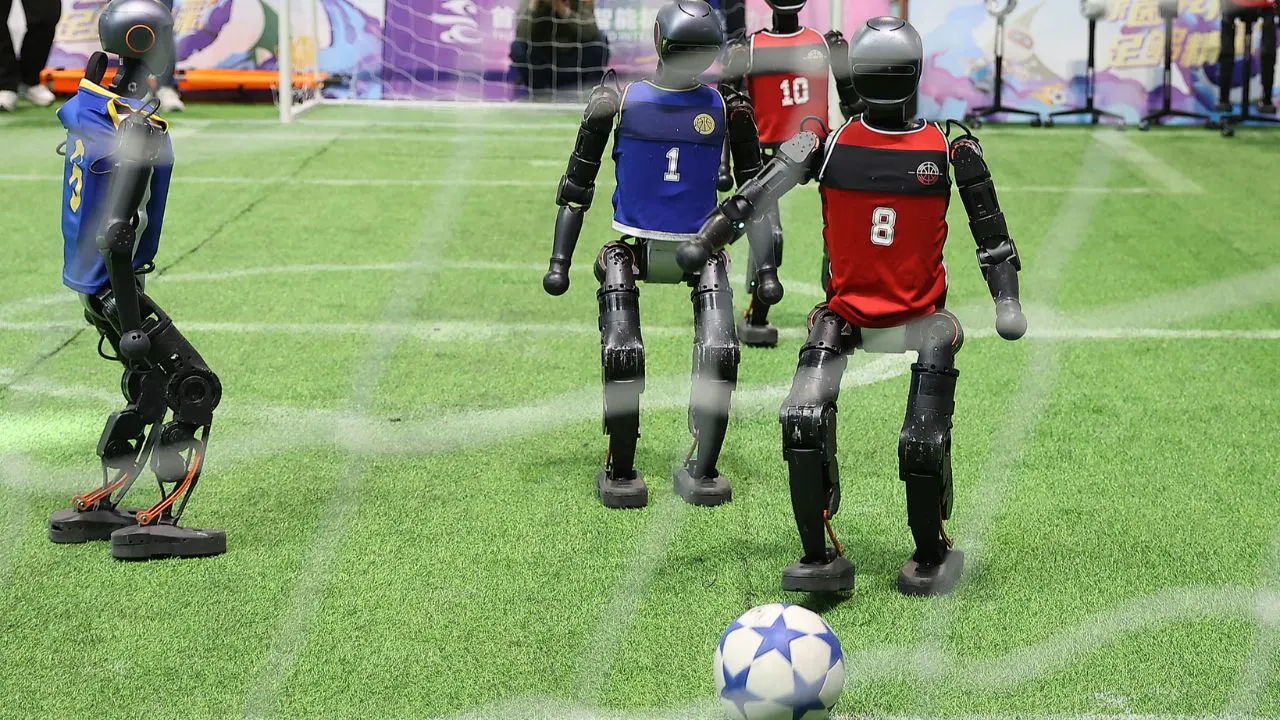
Next week in Beijing, the world will witness the first ever humanoid robot Olympics with more than 500 robots competing in an array of sports and performance events. The National Competition represents a foundation-breaking turning point in the rapidly maturing physical AI sector, especially in China where humanoid robotics research, investment, and innovation has seen unparalleled acceleration.
More than 127 companies across the globe will be displaying their robotic creations at the WRS, also known as the humanoid robot Olympics, officially dubbed the 2025 World Humanoid Robot Games. These will not just be sports events; they will be scenario-based challenges, grand showcases, and collaborative performances. There will be basketball, badminton, table tennis, free fighting, and when all else fails, synchronized group dance at the humanoid robot Olympics.
The domestic robotics industry in China has experienced explosive growth in the past few years. With the help of big names like Tencent and Alibaba, and creating a lot of fervor among investors, a number of companies are already gearing up for IPOs in what has come to be a hyper-competitive and rapidly maturing industry. This event is as much about showcasing technological prowess as it is about the ability of an individual manufacturer to demonstrate the level of agility coordination and fun that humanoid robots have ultimately been able to achieve.
Physical AI—the blend of robotics and AI in the physical world—has rapidly become one of the hottest tech verticals. China: Humanoid robot Olympics show the way startups and established firms are going further by creating robots to be more affordable and accessible. Chinese company Unitree recently debuted a humanoid robot with unique moves and human-like gestures, and while imitation is always the highest form of flattery, this twin’s price might turn a few heads over at Boston Dynamics: Only $5,900.
Like a bizarre Olympics for humanoid robots, the events will showcase an entirely new genre of robotics capable of copying the actions of human athletes and performers. Chinese state media CCTV has also hinted at robots playing sports, boasting surprising quality and precision. Considering the level of dominance China has attained over global manufacturing along with its firm understanding in AI, the humanoid robot Olympics could perhaps be the dawn of a new day in which humanoid robots become a staple in our everyday lives.
But more than the showiness, the event will be a window into the future of robotics in our lives. Ranging from entertainment to sports training to practical work applications, the breakthroughs highlighted at the humanoid robot olympics will help determine how such machines will continue to fit into our world. Just not for fun as the games are always followed executes, the world will be watching the glimpse of its future.
FAQ
The humanoid robot Olympics—formally known as the 2025 World Humanoid Robot Games—will be an international contest during which competing humanoid robots will engage in sporting, performance, and scenario-based events.
Following the humanoid robot Olympics in Beijing in 2025, where over 127 companies and more than 500 robots competed.
Events are basketball, badminton, table tennis, free fighting, group dance, and scenario-based competitions.